
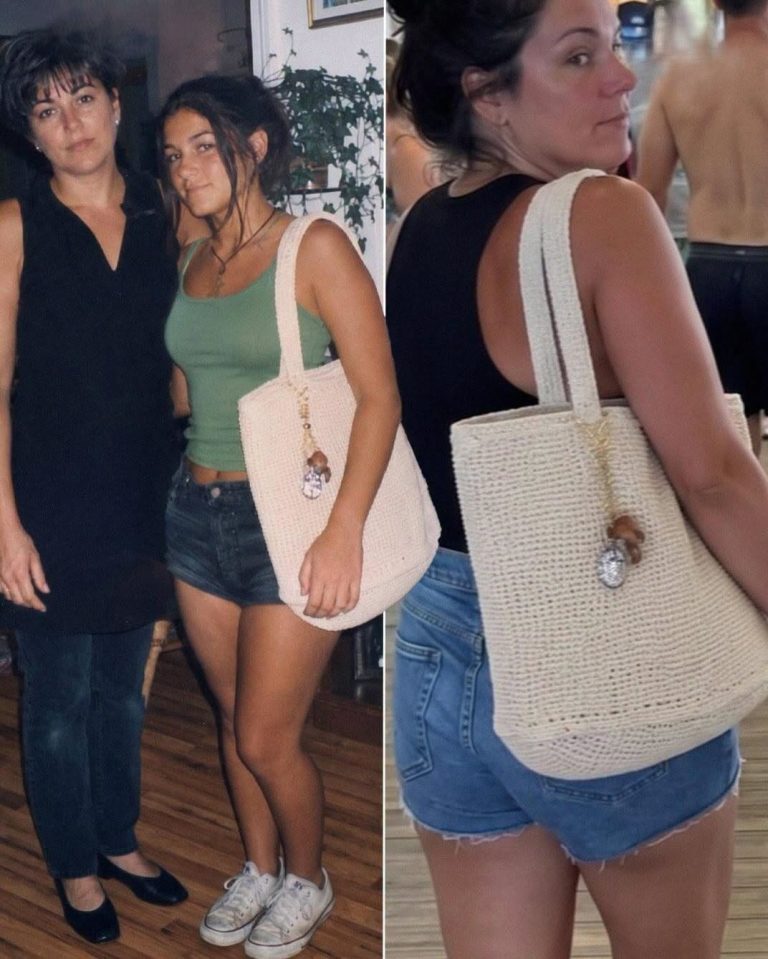
And she was smiling.
Really smiling.
I covered my mouth.
“Oh, God.”
For sixteen years, I had imagined every possible horror.
Hospital rooms.
Roadsides.
Graves.
Locked houses.
But there she was.
Alive after she disappeared.
I turned the photograph over.
In blue ink were two words.
Still here.
I knew the handwriting immediately.
Gia’s.
Dana whispered, “I should have turned it in. I didn’t know.”
I couldn’t answer.
Then I noticed faint writing beneath those words.
Almost rubbed away.
I held the photograph toward the sunlight.
A date.
August 3, 2009.
More than a year after Gia vanished.
My daughter had survived at least another year.
The realization broke something open inside me.
Not relief exactly.
Not grief either.
Something in between.
I looked at the porch in the picture.
White railing.
Blue door.
A hanging fern.
Then I noticed the edge of someone’s hand resting on Gia’s shoulder.
No face.
Just a hand.
“Do you know where this was taken?”
Dana shook her head.
“No.”
Then she removed the bag and set it beside me.
“You should have this.”
I ran my fingers across the crooked handle.
“I can’t.”
“It belonged to her.”
I looked at Dana.
“No. It was hers.”
For sixteen years, I had frozen Gia at seventeen.
I kept her toothbrush.
Renewed her library card.
Repeated the same physical description.
I had preserved the girl who disappeared because she was the only version I still knew.
But the photograph proved something terrifying and wonderful.
My last words had not been the final chapter of her life.
Dana and I exchanged phone numbers.
She promised to help identify the thrift store.
That evening, I called the police.
The photograph became evidence.
Gia’s case was reopened.
Months of searching followed.
Eventually, investigators located the thrift store.
Then an old donation record.
The bag had arrived among boxes from a church shelter.
The shelter had closed years earlier, and almost all its records were gone.
But one former volunteer remembered a girl named Gia.
When the detective called me, I could hear hesitation in his voice.
“There’s something else.”
I gripped the phone.
“What?”
“The volunteer remembers Gia because she was pregnant.”
I stopped breathing.
Pregnant.
Nobody had known.
Not Detective Pruitt.
Not Gia’s friends.
Not me.
Suddenly, our arguments from that final summer rearranged themselves in my memory.
Her moodiness.
The oversized sweatshirt she sometimes wore despite the heat.
The way she stopped eating breakfast.
The panic whenever I mentioned doctors.
Had she been trying to tell me?
Had I been too busy arguing about clothing and curfews to notice?
Gia had left my house at seventeen carrying a beach bag and a secret she had been too frightened to share.
And sixteen years after I shouted, “Then go. See how far you get,” I learned that somewhere in the world, I might have a grandchild who had never even heard my name.
For years, I thought the hardest thing was not knowing whether Gia survived.
Now I knew she had.
At least for a while.
And somehow that made the questions bigger.
Who had been standing behind her in that photograph?
Where had she gone after the shelter?
Had she given birth?
Did she raise the baby?
Was my daughter still alive somewhere, now thirty-three years old?
Or was there a young person walking through the world carrying Gia’s eyes, Gia’s laugh, maybe even that same stubborn tilt of the chin?
I no longer had the luxury of mourning only the seventeen-year-old girl who walked through my front door.
The photograph had changed that.
Gia had grown older.
She had lived experiences I knew nothing about.
She had become somebody beyond the daughter preserved in my memory.
And if there was even the smallest chance that woman—or her child—could still be found, I knew what I had to do.
I would keep looking.
But this time, I wouldn’t be searching only for the girl who left home.
I would search for the woman she became.
And if I found her, I already knew the first words I wanted to say.
Not, “Why did you leave?”
Not, “Why didn’t you call?”
Not even, “Where have you been?”
I would say the words I should have given her sixteen years earlier.
“Gia, you can come home whenever you’re ready.”